
EMDR Therapy in Calgary: How It Works, EMDR vs. CBT, and What to Expect

Trauma is not simply a memory from your past; it is an active biological imprint left behind on your nervous system, your emotional responses, and your body.
When distressing life events — such as childhood emotional neglect, intimate partner distress, volatile relationship patterns, or chronic panic — remain unresolved, your brain struggles to catalogue them as finished. Instead, ordinary triggers in adult life can activate sudden hypervigilance, emotional shutdown, racing thoughts, or a persistent knot in your chest.
Traditional talk therapy can help you analyze these patterns, but cognitive insight alone rarely stops the autonomic nervous system from reacting.
At Shi(f)t Happens in Calgary, Eye Movement Desensitization and Reprocessing (EMDR) provides a somatic and neurobiological pathway to work with unresolved trauma, PTSD, and anxiety without requiring you to recount painful memories out loud in exhausting detail.
How EMDR works in the brain and body
Developed by Dr. Francine Shapiro and recognized as a first-line trauma treatment by the World Health Organization, EMDR is grounded in the Adaptive Information Processing model.
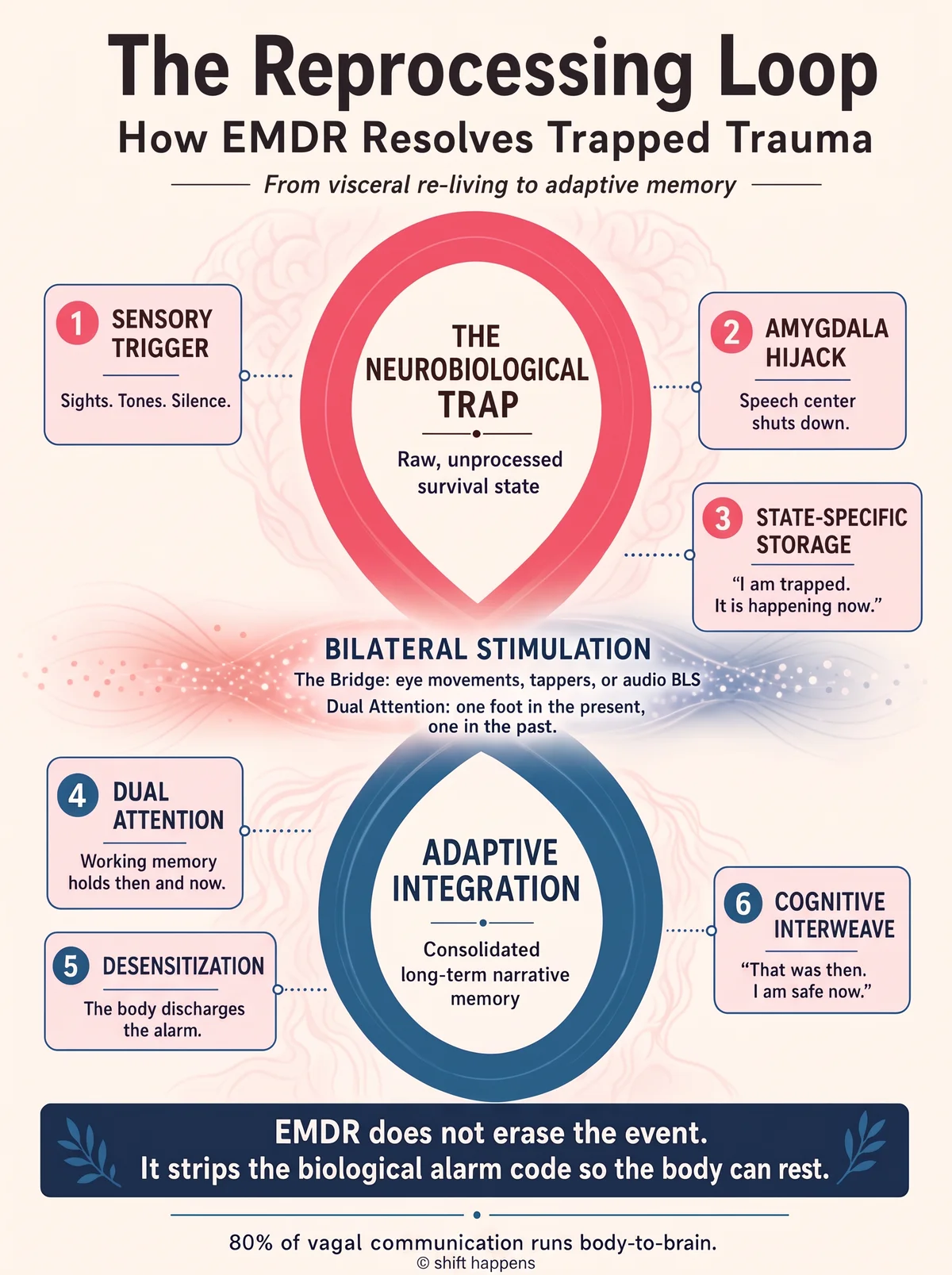
Under normal conditions, your brain processes everyday experiences, extracts useful insights, and files the memory away into long-term storage. During acute relational distress, chronic emotional overwhelm, or traumatic shock, elevated stress neurochemicals disrupt that filing mechanism. The memory becomes trapped in its raw, state-specific form, carrying the original emotions, physical sensations, and negative self-beliefs into present-day life.
The role of bilateral stimulation
EMDR does not rely on medication, hypnosis, or passive conversation. It pairs gentle, brief recall of a distressing target with bilateral stimulation — typically rhythmic side-to-side eye movements, alternating tactile hand pulsors, or gentle bilateral tones.
- Down-regulates the amygdala: Engaging working memory with alternating stimuli reduces autonomic arousal in the brain's survival alarm.
- Supports neurobiological integration: Similar to the memory consolidation that happens during REM sleep, bilateral stimulation allows the emotional limbic system and the prefrontal cortex to communicate, so the memory can be adaptively resolved and filed into past history.
The memory does not disappear, but it loses its emotional charge. You can recall what happened with calm neutrality, recognizing internally: that was then, this is now, and I am safe today.
EMDR vs. CBT for trauma: which fits you?
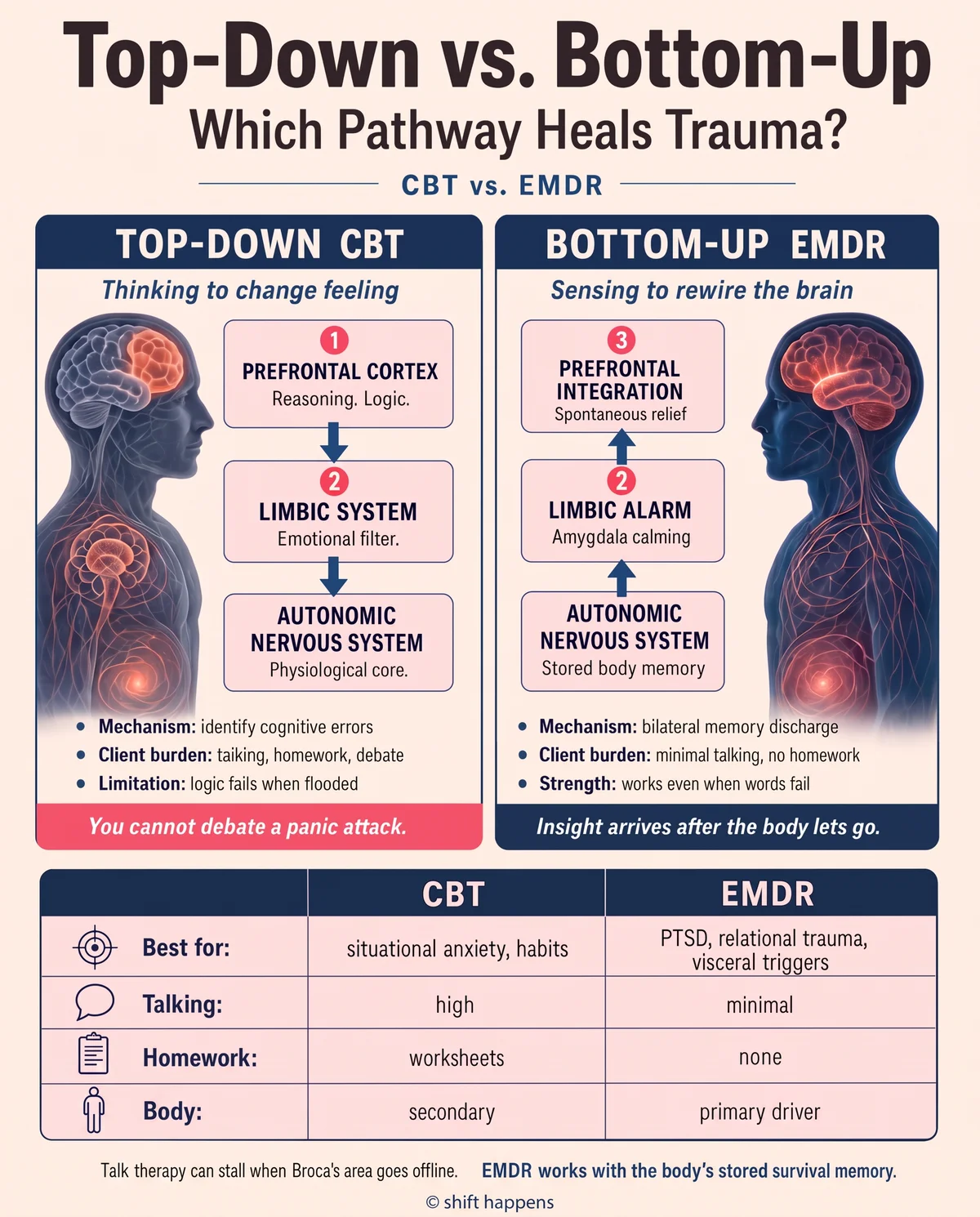
Both EMDR and Cognitive Behavioural Therapy are empirically supported treatments for trauma and PTSD, yet they approach healing from opposite directions. CBT is top-down, using conscious reasoning, logic, and cognitive reframing to challenge distorted thoughts. EMDR is bottom-up, using somatic awareness and memory reprocessing to discharge physiological survival stress held in the body.
Side-by-side comparison
- Therapeutic approach: EMDR targets the nervous system and physiological memory storage directly. CBT targets conscious cognitive distortions and unhelpful thought loops.
- Verbal narration needed: EMDR requires minimal narration — you do not have to describe traumatic memories out loud in detail. CBT relies more heavily on verbal exploration, worksheets, and discussion.
- Primary mechanism: EMDR uses dual-attention bilateral stimulation through eye movements, tactile taps, or auditory tones. CBT uses cognitive restructuring, core belief reframing, and behavioural exposure.
- Between-session homework: EMDR processing happens inside the session, with a focus on gentle self-care in between. CBT typically involves daily thought logs, exposure ladders, and behavioural tracking.
- Best suited for: EMDR suits visceral triggers, relational and developmental trauma, fawning, and body-held tension. CBT suits situational anxiety, specific phobias, everyday worry rumination, and cognitive restructuring.
When EMDR may be the better starting point
- Your body stays activated — shallow breathing, stomach knots, elevated heart rate — even when you know intellectually that you are safe.
- You have analyzed your past for years, but your emotional reactions have not shifted.
- You carry deep, visceral negative beliefs such as “I am powerless,” “It was my fault,” or “I am not safe.”
- Talking about painful experiences causes intense dissociation or emotional flooding.
When CBT may be the better starting point
- You are seeking structured, analytical tools for everyday workplace stress or situational worry.
- You prefer clear homework assignments, thought records, and step-by-step cognitive challenges.
- Your distress is mainly future-oriented worry rather than past traumatic memories.
What happens in an EMDR session: the eight phases
EMDR is not an unstructured technique. It is a rigorous eight-phase clinical protocol designed to prioritize your safety and control at every step, and you never have to recount memories in exhaustive detail.
- 1. History taking and target mapping: We identify the relational themes, present-day triggers, and past foundational experiences that formed your distress patterns.
- 2. Preparation and resourcing: Before touching difficult memories, we establish grounding exercises, somatic regulation tools, and internal resource states so your nervous system stays contained. This phase matters most, and we do not rush it.
- 3. Assessment: We identify the specific target memory, the negative self-belief attached to it, the desired positive belief, and where tension sits in your body.
- 4. Desensitization: You focus on the target while engaging in sets of bilateral stimulation, briefly reporting whatever sensation, thought, or feeling arises between sets.
- 5. Installation: We reinforce and anchor a grounded positive belief, such as “I am capable of protecting myself now.”
- 6. Body scan: We check for lingering somatic tension — jaw clenching, chest tightness, stomach knots — and clear it with further bilateral stimulation.
- 7. Closure: Every session concludes with intentional grounding so you leave fully regulated and oriented to the present.
- 8. Re-evaluation: At the start of the following session, we check the target to confirm that disturbance remains low and positive shifts hold.
In-person in South Calgary or secure virtual across Alberta
In-person sessions take place at the Thrive Business Centre in Southeast Calgary (11500 29 Street SE), in a calm, sound-private space with tactile bilateral tools such as hand pulsors or visual light tracking.
Virtual EMDR is conducted over an encrypted, PIPEDA- and HIA-compliant Canadian telehealth platform, using bilateral software or self-tapping protocols. It works well if you would rather process from your own sofa, want to avoid a winter commute after deep emotional work, or live outside Calgary in Edmonton, Red Deer, Lethbridge, Medicine Hat, or a rural community.
Fees, insurance, and direct billing
Individual EMDR sessions are $235 for 50 minutes, booked in a one-hour slot, and psychological services are GST-exempt. Extended sessions are available on clinical recommendation for deeper reprocessing.
Services provided by a provisionally registered psychologist are covered under most extended health benefit plans in Alberta. Direct billing is available to Alberta Blue Cross, Medavie Blue Cross, Sun Life, and Green Shield Canada, and official clinical receipts are provided for all other insurers.
Common questions about EMDR
Do I have to describe my trauma in detail?
No. Unlike traditional exposure therapy or narrative counselling, EMDR does not require you to describe traumatic experiences out loud. You only need to hold the memory in your awareness while tracking the bilateral stimulation, sharing brief shifts between sets.
Is EMDR like hypnosis?
No. You remain fully conscious, awake, and in control throughout the appointment, and you can pause or stop at any moment.
How many sessions does EMDR take?
It depends on whether you are working through a single stressful event or complex relational trauma. Single-event processing can sometimes resolve in six to ten sessions, while developmental trauma often involves a longer preparation phase to build nervous-system capacity first.
Can EMDR be done virtually?
Yes. Virtual sessions use secure bilateral stimulation tools or guided self-tapping. We discuss together whether virtual EMDR suits your needs and your environment.
Starting EMDR in Calgary or across Alberta
You do not have to live at the mercy of unresolved triggers or spend years talking around your pain. If you would like to find out whether EMDR fits your goals, a free 15-minute consultation is a good place to start.