
Stress or Burnout? How to Tell the Difference (and What Can Help)

Ever been tired in a way that a full night's sleep, a long weekend, or even a tropical vacation doesn't touch? You're not imagining it, and you're definitely not "just not as tough as you used to be." (That's a myth, by the way.)
Let's talk about the difference between stress and burnout, and what you can start doing about it. Go ahead and close a few of those 800 open browser tabs first.
What is burnout, anyway?
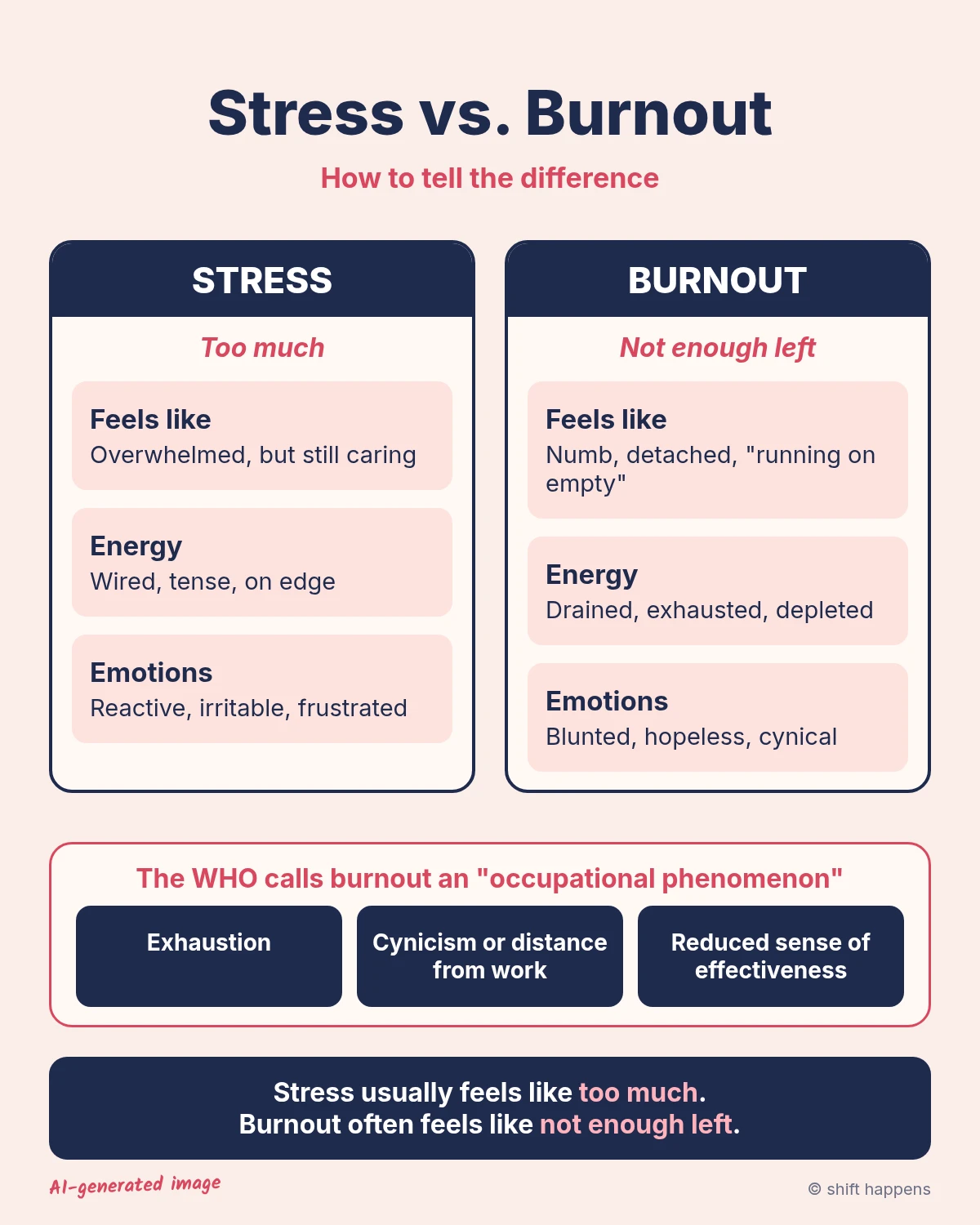
Burnout isn't a medical diagnosis. The World Health Organization describes it as an occupational phenomenon: exhaustion, cynicism and a reduced sense of effectiveness that come from chronic stress that hasn't been successfully managed.
In plain language, burnout tends to show up as three things:
- Emotional exhaustion: running on empty, even after rest
- Cynicism or detachment: feeling numb, checked out or distant from work and people you used to care about
- Reduced sense of accomplishment: feeling like nothing you do is enough, or that you're not as capable as you used to be
When I boil it down, burnout can be summed up in two words: unsustainable effort.
And burnout isn't only a job thing. Parents (moms especially), caregivers and the "everyone's go-to person" carry constant, invisible work that never really clocks out.
Stress vs burnout: a quick comparison
Stress and burnout overlap, but here's a simple way to tell them apart:
| Stress | Burnout | |
|---|---|---|
| Feels like | Overwhelmed, but still caring | Numb, detached, "running on empty" |
| Energy | Wired, tense, on edge | Drained, exhausted, depleted |
| Emotions | Reactive, irritable, frustrated | Blunted, hopeless, cynical |
| Motivation | Still trying to keep up | Loss of interest, apathy |
| Body | Headaches, muscle tension, sleep issues | Ongoing fatigue, getting sick more often, insomnia |
| Focus | Scattered and forgetful, but present | Hard to concentrate, "checked out" |
| What tends to help | Short breaks, support, self-care | Rest, boundaries, professional support, re-evaluating commitments |
A helpful shorthand: stress usually feels like too much. Burnout often feels like not enough left.
Signs worth paying attention to
Burnout tends to sneak up gradually. Some signs to notice:
- In your body: exhaustion that rest doesn't fix, headaches, stomach troubles, muscle aches, changes in sleep or appetite, catching every bug going around
- In your mood and mind: irritability or short fuses, cynicism, hopelessness, losing interest in things that used to matter, trouble concentrating or feeling creative
- In what you do: pulling away from people, procrastinating or avoiding responsibilities, leaning more on alcohol or other substances to cope
Psychologists Herbert Freudenberger and Gail North described burnout as unfolding in stages, often starting with something that looks like a strength: high drive, a need to prove yourself, and working harder and harder. Self-care slides, work takes over, and the warning signs get explained away. Denial, oddly enough, is one of the stages.
A few myths, busted
Burnout was first described in the 1970s, yet these myths still hang around: that it's rising because we're less tough, that it's easy to spot, that it's no big deal, or that it's only about poor self-care. None of them are true.
Burnout is shaped by workload, time pressure, role conflict, lack of support or autonomy, unfairness, a mismatch between your values and your work, and what's happening at home. It's not a personal failing.
Small, sustainable steps
No giant self-improvement project required. Start small.
- 1. Check in with yourself. Close your eyes for 10 to 20 seconds and scan from head to toe. On a scale of 1 to 10, how are you really doing? Noticing is the first step.
- 2. Sort what you can change from what you can't. If a stressor is within your control, problem-solve: adjust your schedule, delegate, set a boundary. If it isn't, focus on managing the emotional load with breathwork, journaling, movement or talking it through with someone you trust.
- 3. Rethink "success." What does success mean to you, and where did that definition come from? If it's costing you your health, sleep and relationships, it may be time for a definition built on sustainable success.
- 4. Protect pleasure and leisure. Is fun a priority, or an "extra, if there's time"? Rest and play are part of the plan, not a reward for finishing it.
- 5. Practice saying no. My favourite rule of thumb: if it's not a "hell yes," it's a no.
- 6. Habit-stack a tiny mindfulness practice. Attach something new to something you already do. For example, three minutes of mindful breathing right after you brush your teeth. Simple beats ambitious.
If you like a framework, Dr. Jacinta Jiménez's book The Burnout Fix offers the PULSE practices: Pacing for performance, Undoing unhelpful thought patterns, Leveraging leisure and social connection, Self-care and Evaluating effort.
When to reach out for support
Burnout is hard to "fix" with a weekend off, because it's about root causes, not just symptoms. If what you're feeling has been hanging around for weeks, is affecting your daily life, work or relationships, or you just don't feel like yourself, talking it through with someone can help. Reaching out takes courage. It isn't a sign of weakness.
This post is general education, not a diagnosis or a substitute for individual care.
I'm Sheri Boyd, a registered provisional psychologist at Shi(f)t Happens. I offer sessions in person in SE Calgary and virtually anywhere in Alberta. If something here sounded familiar, I'd be glad to talk it through with you. You can book online whenever you're ready.
Because you can't pour from an empty cup, and you matter too.
If you are in crisis or thinking about harming yourself, call 911 or go to your nearest emergency department. You can also call or text 988 (Suicide Crisis Helpline, 24/7) or the Alberta Mental Health Help Line at 1-877-303-2642 (24/7).